Allergens in takeaway and delivery food packaging
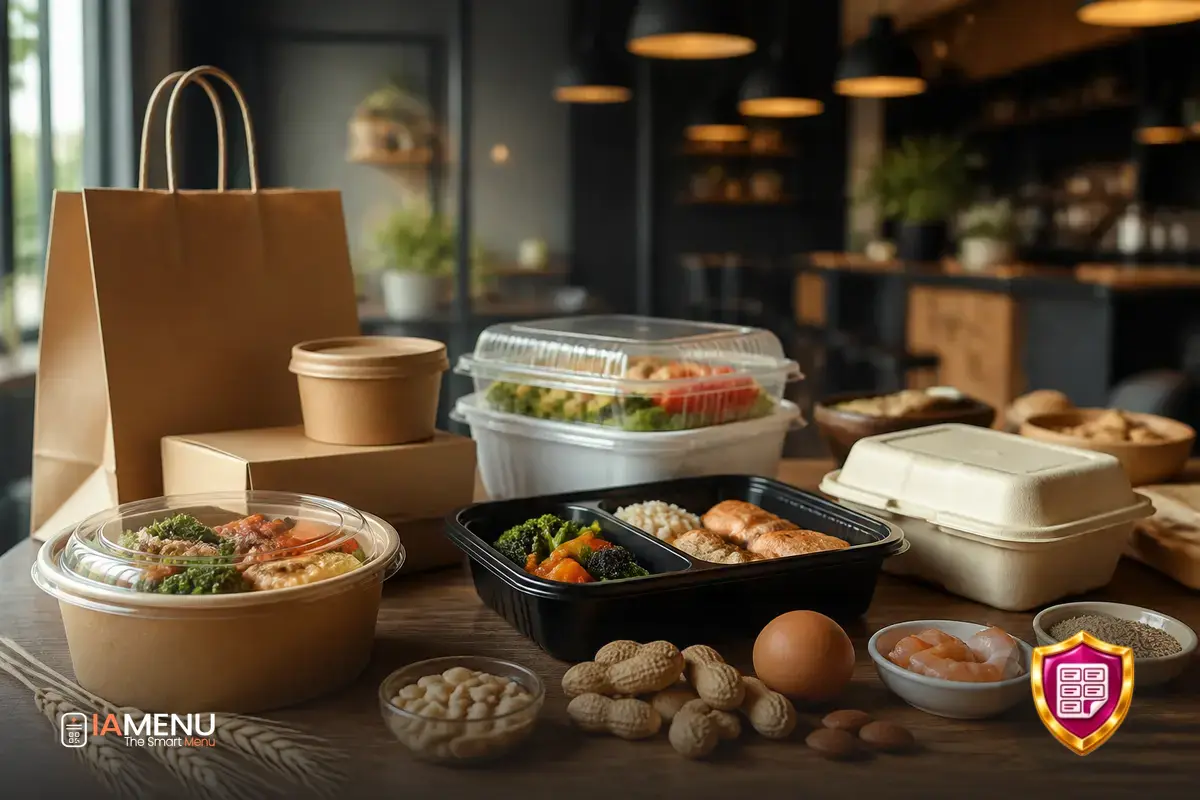
Takeaway and delivery orders leave the team’s direct control as soon as they go out the door, but allergen information must accompany them with the same precision as in the dining room. Customers may view the menu on a platform, place an order via WhatsApp, or collect it from the restaurant and, in every case, they need to know what the dish contains before buying it and receive clear identification when it is handed over.
Managing allergens on takeaway and delivery food containers does not mean sticking the same label on every bag. You need to connect the actual recipe, the published information, the container, and the specific order. Regulation (EU) 1169/2011 establishes the framework for food information provided to consumers; the restaurant’s daily challenge is applying it without relying on memory, outdated sheets, or labels written in a hurry during service.
Why the container is also part of the information
When a dish is served in the dining room, staff can answer questions, consult a product sheet, or confirm a modification. With a takeaway order, the customer receives a closed container, a bag, and perhaps several dishes together. If the information exists only on the online menu or in the conversation with the person who took the order, it can be lost precisely when the food reaches another member of the family.
That is why it helps to think about two separate moments: before purchase and at delivery. The first allows the customer to make an informed decision. The second confirms which preparation each container contains and reduces the risk of mixing up dishes, especially with large orders or several versions of the same recipe.
The practical rule for the team
Order information should follow this path: updated recipe, menu or sales channel, internal receipt, and container. If any of these points shows different data, the customer does not receive a consistent answer.
A dish should not leave the kitchen with a label that the team cannot link to its ingredient sheet.
What Regulation (EU) 1169/2011 requires
Regulation (EU) 1169/2011 governs food information provided to consumers. One of its principles is the obligation to provide information about substances or products that cause allergies or intolerances when they are present in food, and to present that information clearly so consumers can identify it.
For packaged food, the information must accompany the food and cannot be hidden behind an ambiguous statement. When there is an ingredient list, allergens must be visually distinguished within it. In a takeaway food operation, the restaurant must also organize the information so customers can consult it during the purchasing process and relate it to what they receive.
The Regulation also covers distance selling. This is especially relevant for a restaurant’s own website, a QR menu with ordering functionality, WhatsApp, or a delivery platform: mandatory food information must be available before the customer completes the purchase and accompany the food on delivery where applicable.
Do not confuse “providing information” with “adding an icon”
An icon can make information quicker to scan, but it needs to be connected to an understandable legend and the correct recipe. A symbol for wheat, milk, or nuts does not solve the problem if the customer does not know what it means or if the dish has changed supplier.
- • Identify the dish or container reference.
- • Use wording the customer can understand.
- • Highlight the allergens present according to the actual preparation.
- • Review the information whenever an ingredient changes.
Allergens before purchase on menus, websites, and platforms
The restaurant’s first operational obligation is to ensure that customers do not have to guess. A dish description should display its allergens clearly before the customer adds it to the cart, reserves it, or confirms the order. It is not enough to place a general note at the end of the menu saying “ask staff” if the purchasing channel does not offer a reasonable way to check the preparation.
On a digital menu, each dish can include its allergens alongside the ingredients or in a clearly linked section. On an external platform, you need to make use of the available fields and check that the information is not lost when the menu is copied over. If the platform limits the content, the restaurant must establish a procedure that allows customers to consult the information before confirming, without presenting an incomplete description as if it were sufficient.
This point often fails when the dining-room menu is up to date but the delivery menu still contains an older version. The solution is to work from a primary source and review every channel after changing a recipe. Integrated allergen management in the menu helps reduce this duplication and identify discrepancies earlier.
Example: one recipe, three information points
Imagine a burger with wheat bread, cheese, and a sauce containing mustard. Before purchase, those allergens must appear on the dish page. When the order is prepared, the label or identification must correspond to that specific burger. At delivery, the customer must be able to distinguish it from a version without cheese or with a different sauce.
If the sauce changes and only the kitchen information is updated, the menu and the container stop telling the same story.
What should accompany the order at delivery
Delivery should not turn into an improvised explanation. The order should leave the restaurant with identification that links each container to its dish and allows customers to check its allergens without opening every package. Depending on the restaurant’s workflow, this identification can be included on the label, the order receipt, or information that clearly accompanies the food.
For orders with several dishes, practical traceability is just as important as the wording. A bag with four unnamed containers forces the customer to open them or rely on a later phone response. A label with the dish name and its allergens reduces confusion and helps the delivery team hand over the correct order.
The information must be legible under normal conditions of use. Tiny text, a sticker placed over existing text, or printing that fades with moisture can turn an apparently correct label into a tool of limited value. It is also worth deciding where the label goes: it should be readable without removing it or unnecessarily handling the food.
Checklist before sealing the bag
- • Does the dish name match the order?
- • Does the label correspond to the recipe and the requested modification?
- • Are the allergens clearly readable?
- • Are the sticker or ink still visible on the container?
- • Are the dishes in the same order clearly differentiated?
- • Does the information provided match what the customer saw when purchasing?
The problem with a generic label for every container
One of the most common practices is buying a label with a broad list of allergens and sticking it on every order. It seems convenient, but it creates two problems: it may declare substances that are not in the dish and, at the same time, fail to accurately identify those that are part of the recipe. The customer receives a general warning instead of information about their food.
It is also not enough to write “contains allergens” without explaining which ones. People need to identify the substance or product present. If one recipe contains egg, milk, and mustard, the label should reflect that combination; if another preparation does not include those ingredients, it should not automatically inherit the same list.
Generic labels may have a very limited internal use, such as reminding staff of a handling instruction, but they should not replace the specific identification received by the customer. Information must be generated from the actual dish, not from the type of container or a template that is never reviewed.
The question that reveals the problem
Ask your team: “Can we find out which allergens this container contains without opening the order or calling the kitchen?” If the answer is no, the label is not meeting the customer’s needs, even if it has many symbols or a long warning.
Why “may contain” does not work for everything
The expression “may contain” is sometimes used as a shortcut to cover every possibility. The problem is that it does not distinguish between an allergen that is part of the recipe and possible accidental presence resulting from cross-contamination. These are different situations, and customers need them to be distinguished.
If a sauce contains milk as an ingredient, it is not enough to write “may contain milk.” This wording turns a known presence into a vague possibility. Similarly, adding every allergen to every dish can reduce the value of the information and leave customers unsure about what they actually need to avoid.
Warnings about possible traces should be based on an analysis of the process, handling, equipment, suppliers, and the establishment’s control measures. They are not a safety net to compensate for a poorly documented recipe. If the restaurant is not clear about what each dish contains, the first task is to organize the ingredient sheets and review how the dishes are prepared.
Two messages that should not be mixed
Ingredient present: the allergen is part of the recipe and must be identified as such.
Possible cross-contamination: there is a process-related risk that must be assessed and communicated responsibly, without using it to replace the ingredient list.
How to handle changes, substitutions, and customized orders
Takeaway orders change frequently: a customer removes a sauce, adds cheese, requests a different side, or asks for an adaptation. Each modification can alter the allergen information. That is why the standard dish sheet is a starting point, not an automatic guarantee for every combination.
The team needs to know which modifications are permitted and how they affect the information. If an ingredient that contributes an allergen is removed, the label should not retain it without review. If a topping is added or the bread is replaced, the order must inherit the information for the new combination.
Less visible changes also need to be reviewed. A supplier may replace one brand with another, a prepared sauce may change its formulation, or an ingredient that previously did not include an allergen may acquire a new one. Label review starts when goods are received and ends with the sales channels.
A simple procedure for every change
- Update the dish’s ingredient sheet.
- Confirm the allergens associated with the new composition.
- Review the digital menu, website, and external platforms.
- Update the label template or printing system.
- Inform the kitchen, front-of-house, and delivery teams.
How to stop recreating labels by hand
Manual work fails for a simple reason: the same information is copied too many times. A restaurant may have a spreadsheet for the kitchen, a PDF menu, a listing on a delivery platform, a sticker template, and a training document. After several changes, each version tells a different story.
The alternative is to build a single source of information. Each dish should have a name, ingredients, variations, and associated allergens. From that foundation, you can generate the menu, order view, and container identification, always with human review before publishing important changes.
An AI-powered digital menu solution can help structure data and detect inconsistencies, but it does not replace validation by the person responsible for the establishment. AI should not invent ingredients or decide on its own whether a supplier has changed a formulation. Its value lies in reducing transcription and making it clear where review is still needed.
The goal is not to print an incorrect label faster. It is to ensure that a properly made update reaches every point: menu, order, kitchen, and container. With this workflow, the team spends less time copying information and more time checking that the actual preparation matches what is being communicated.
What a dish sheet should contain
- • Commercial name and internal name.
- • Ingredients and separate components, such as sauces or toppings.
- • Allergens associated with each component.
- • Permitted variations and changes that modify the information.
- • Date of the last review and person responsible.
- • Link to the label or format that goes out with the order.
How to review the restaurant’s allergen system
You do not have to wait for an incident to occur before reviewing the process. A periodic check can begin with ten real orders from different channels: in-store pickup, in-house delivery, and an external platform. Compare what the customer saw before purchasing with what appears on the container and with the recipe prepared by the kitchen.
Record each discrepancy without looking for someone to blame. It may be a label that was not printed, a dish that appears without allergens on a platform, a modification that does not update the dish sheet, or an ingredient documented under an old brand. The goal is to correct the process, not add another instruction the team has to remember under pressure.
It is also worth defining who approves changes, who updates the information, and who checks the first labels. If everyone can edit without a shared standard, speed turns into contradictory versions. If no one can edit, the menu eventually becomes outdated. A clear owner and a simple record solve much of the problem.
To organize the operation as a whole, you can review how a compliance-focused digital menu fits with your internal processes. And if you receive many repeated questions during service, an AI assistant for restaurants can help centralize answers based on information validated by your team.
A useful review in under an hour
Choose one dish with a simple recipe, another with several sauces, and another with common modifications. Place one order for each, check the information available before purchase, review the label, and ask the team what they would do if an ingredient changed.
If all three answers match and can be justified using the dish sheet, you have a solid foundation. If they do not match, you already know where to start making corrections.
Conclusion: customers should receive the same information they consulted
Managing allergens on takeaway and delivery food containers requires connecting two moments that are often handled separately: the purchase decision and the delivery. The information must be clear before the order is confirmed, correspond to the actual recipe, and travel with the food in a way that allows each preparation to be identified.
Generic labels, “may contain” warnings applied to everything, and sheets updated once a year do not solve this need. A single database of dishes, ingredients, and allergens reduces copy errors and allows the digital menu and the container to work with the same information, always with restaurant review.
Frequently asked questions
These are the most common questions about the allergen information that should accompany takeaway and delivery orders.
What allergen information should accompany takeaway food?
The presence of relevant allergens in each preparation must be communicated and available to the customer before purchase and when the order is received. The exact format depends on how the food is offered and packaged, but the information must correspond to the actual recipe and remain with the order.
Do allergens have to appear on the container label?
When the food is presented as packaged food, the mandatory information must accompany it in accordance with Regulation (EU) 1169/2011. If the order is delivered in a takeaway container, the identification must be clear and must not be separated in a way that could mislead the customer.
Do allergens have to be provided before purchase on a delivery app?
Yes. Mandatory food information must be available before the purchase is completed when the order is placed remotely. The dish page, digital menu, or ordering channel must reflect the allergens in the preparation the customer will receive.
Is a generic allergen label on every container enough?
It is not a reliable solution if all dishes do not contain the same ingredients. A generic label may omit an allergen that is present or list others that do not apply, so each order must be linked to its recipe and allergens.
Can you write “may contain” for every dish?
It should not be used as a substitute for identifying the ingredients present in the recipe. Statements about possible traces should be based on a real assessment of the risk of cross-contamination and should not replace information about the allergens that are part of the dish.
Who should review the allergens in delivery orders?
Responsibility for ensuring that the information is correct lies with the operator offering and preparing the food, even when the order arrives through an external platform. The team must review recipes, ingredients, supplier changes, and substitutions before publishing or printing the information.
What happens if an ingredient in a recipe changes?
The change may alter the dish’s allergens, even if the recipe appears practically unchanged. You need to update the dish sheet, digital menu, label, and any system that generates information for orders before continuing to use the previous materials.
How can you avoid recreating allergen labels by hand?
The safest approach is to work with a single database of dishes, ingredients, and allergens that generates the menu and order information. This way, an update can be reviewed in one place and then applied to sales channels and labels.
If you want to organize this process from menu to order, discover how an AI allergen menu works in 2026 and assess which parts of your process you can stop managing manually.